When a Novel Becomes a Film, What Gets Left Behind?
Novel-to-film adaptation turns private narration into images, sound and performance. Learn to track what changes—and what a film gains in return.
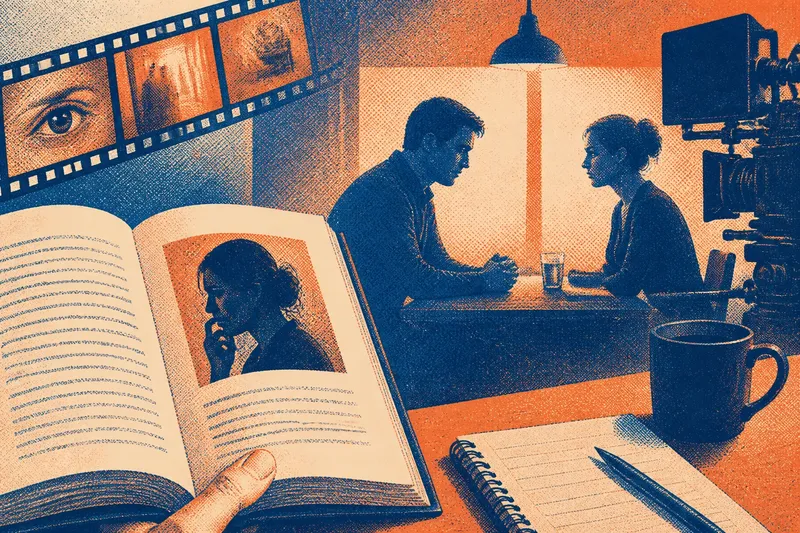
When a novel-to-film adaptation reaches the scene where a character changes their mind, the page can tell you so in a sentence; the screen has to make that change visible or audible. That shift is where the interesting work begins: not in counting omitted chapters, but in noticing how a film gives shape to thoughts you once encountered privately.
Read or watch with one question in mind: what did the narration let me know, and what has the film chosen to show, sound or leave uncertain? Follow the process in order, and you can distinguish a necessary change in medium from a change in meaning.
What did the novel let you know from inside?
Start with a passage in which narration does more than report events. It might describe a character’s private judgement, move freely between past and present, tell you something the character does not yet understand, or linger over a detail that has no immediate effect on the plot.
Write down the information the passage gives you, rather than simply its wording. For instance: “Mara smiles while privately resenting the invitation” captures a useful contrast. The sentence supplies a feeling and a performance at once. A camera can record the smile, but it cannot directly photograph resentment.
Notice who is telling the story, too. A first-person narrator may be unreliable, selective or amused by their own mistakes. A close third-person narrator may colour ordinary surroundings with one character’s fears. A detached narrator may know what several people think. These are different kinds of access, and a film cannot reproduce them merely by putting a voice-over on the soundtrack.
Which parts of the passage need translating?
Separate the passage into jobs. Does it give information, establish mood, reveal a contradiction, shape the pace, or make you sympathise with someone? A single paragraph can do several things, so list the functions that matter most to your reading.
Then ask which of those functions the film must preserve for the scene to make sense. It may be essential that the audience knows Mara is concealing something, while the exact metaphor the narrator uses to describe her irritation may be expendable. This is not a judgement about whether prose is better. It is a way to see what the adaptation is solving.
Imagine a novel describes a teenager counting the cracks in a classroom wall to avoid answering a teacher. The film could hold on the student’s eyes, let the teacher’s question hang in the room, then show a fingertip tracing a crack. The action makes avoidance legible without copying the sentence. The expected observable result is that viewers can read the student’s hesitation, though they may not know every thought behind it.
For each function, consider several possible carriers: a face or gesture, a prop, the arrangement of bodies, a cut, music, ambient sound, dialogue, or voice-over. Keep the question open for now. A gesture can suggest private feeling, but it can also be ambiguous; that ambiguity may be exactly what the scene needs.
How can a film make a private thought legible?
Look first at performance and framing. A character who answers too quickly, avoids another person’s eyes, or keeps smoothing an already-flat sleeve offers visible behaviour for the audience to interpret. A close-up may make a small response prominent; a wider frame may show the distance between characters instead.
Next, listen for what the image alone does not convey. A sound bridge can carry the mood of one moment into another. A pause, a change in room tone, or a repeated sound can give a scene a subjective quality without explaining it aloud. Music can guide emotion, but it can also flatten uncertainty by telling viewers too directly what to feel.
Pay attention to editing. A cut from a character’s fixed smile to the empty chair across the room can invite a connection between expression and absence. That connection is not the same as a narrator stating what the character feels. The viewer must complete it, so the film’s version may feel more open—or more evasive.
Dialogue and voice-over are still available. The useful question is what each is doing. Dialogue can reveal a character’s attempt to persuade someone else, while voice-over can preserve a distinctive narrator, add distance between speech and image, or expose a mismatch between what a person says and what they do. If narration simply repeats what the screen already makes obvious, ask whether the repetition has a purpose.
What should you compare as the scene unfolds?
Watch the chosen passage once without pausing. Note the scene’s basic events, then watch again for its signals: who gets the close-up, what remains outside the frame, when the soundtrack changes, and whether the edit follows one character’s attention or moves beyond it.
Now compare those choices with the jobs you identified on the page. You do not need to make a point-by-point inventory of every sentence. Focus on the passage’s most important effects and ask whether the film keeps them, shifts them to a different device, or drops them.
- Access: What can you know about a character’s thoughts in the novel? What clues, if any, offer comparable access in the film?
- Point of view: Does the film stay close to one person, or does the camera show events that person could not see?
- Timing: Has a brief thought become a pause, or has a long passage become a quick cut?
- Ambiguity: Does the film settle a question the book leaves open, or make a clear explanation less certain?
- Emphasis: Which image or sound now carries the weight that prose once carried?
- Audience knowledge: Does the film tell viewers something earlier, later or differently from the novel?
Say you are comparing a chapter in which a father warmly welcomes a guest while privately fearing that the guest knows his secret. The film shows the handshake, then holds briefly on the father’s grip after the guest has turned away. You might note that the hidden fear is no longer stated as a fact; pressure in the gesture becomes a clue, leaving viewers to judge how much it means.
That distinction helps avoid a common dead end: calling every absent sentence a loss. If the film replaces a paragraph’s work with a performance, sound cue or cut, the passage has changed form. If no equivalent signal appears, the information or effect may genuinely have been left behind.
Why does some narration disappear altogether?
Sometimes the film wants the audience to share a character’s uncertainty rather than receive a private explanation. A narrator who describes a motive can make that motive settled; an image that shows only an action leaves room to question it. The change can shift how viewers judge a character, even if the external events stay much the same.
Other passages depend on the particular pleasure of prose: a narrator’s wit, a rhythm of reflection, or an argument that unfolds through language. A film may preserve the argument in dialogue or voice-over, but it may instead find a visual pattern that suits its own form. Neither choice is automatically more faithful. Ask what kind of attention each version asks from you.
Compression also alters emphasis. A novel may spend time inside several people’s reactions; a film may focus on one face and let other responses pass at the edge of the frame. The scene then becomes less about a spread of private thoughts and more about the person the camera chooses to follow.
It is not worth the effort to score each scene as faithful or unfaithful by tallying details. That approach treats the novel as a list of items to preserve and misses the film’s choices about access, uncertainty and attention. One carefully examined passage can reveal more than a long catalogue of cuts.
How do viewpoint and narration change on screen?
Can a camera show what a narrator thinks?
Not directly: it can show behaviour, setting and objects that invite an interpretation. Whether viewers read those signs as a particular thought depends on context, performance and what the film has already led them to expect.
When does voice-over suit an adaptation?
Voice-over can preserve a narrator’s personality or make a deliberate contrast between spoken thought and visible action. It feels redundant when it only names details the image has already made clear, unless that repetition is itself part of the characterisation.
Does a close-up reveal a character’s real feelings?
A close-up draws attention to a face, but it does not settle what the expression means. A guarded smile might signal discomfort, politeness or calculation; the scene’s surrounding clues shape how confidently viewers can interpret it.
What if the film changes the point of view?
Track who can see or know what is happening in each version. If the film shows events beyond a novel’s narrator, it may make the audience less dependent on that narrator—or invite a different kind of uncertainty.
How can you describe what the adaptation has changed?
Build your observation in three parts: name the novel’s source of access, identify the film’s replacement or omission, and explain the effect on the viewer. For example: “The chapter states that Mara regrets agreeing to the invitation; the film gives us her tightened smile and a long pause, so the regret becomes a reading rather than a fact.”
Keep the claim close to what you can point to. “The film ruins the character” is hard to support; “the film removes the narrator’s explanation, so the character’s silence seems more calculating” identifies a choice and its likely effect. Another viewer may read the same silence differently, and that disagreement can be useful if you can both name the evidence.
For a whole film, follow one recurring feature rather than trying to explain every adaptation decision. You might trace how the novel’s narrator judges a particular character, then notice whether the camera, dialogue or sound continues to invite that judgement. The pattern can reveal whether the film preserves the narrator’s influence, transfers it to another character, or leaves the audience to decide.
Novel-to-film adaptation is easiest to understand when you treat private narration as a set of functions, not a stack of sentences waiting to be copied. As you watch, ask what the page let you know, what the screen makes available instead, and what remains unresolved; that question shows both what was left behind and what the film has made possible.