Mystery or Thriller: Where the Suspense Comes From
Mystery or thriller: learn how information puzzles invite deduction while looming consequences create tension, and spot how films can combine both.
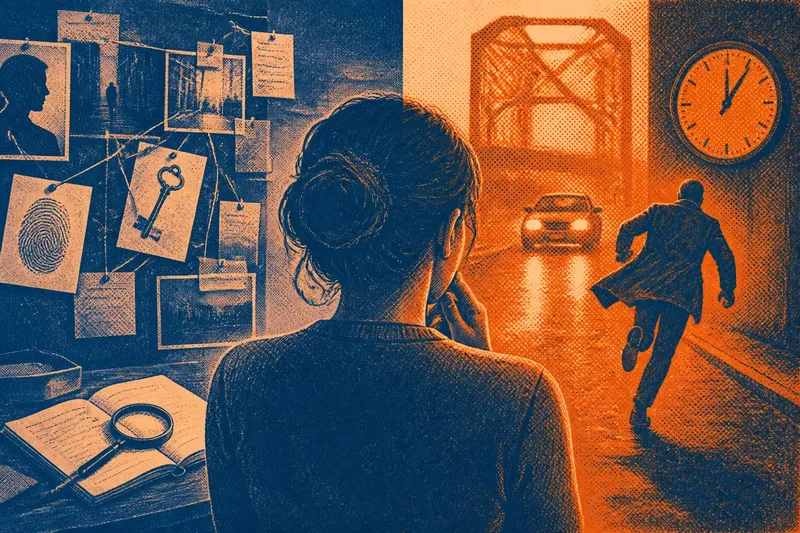
In a mystery or thriller, the suspense can come from two very different questions: What happened? and What will happen next? A detective tracing a hidden motive invites you to arrange clues; a driver racing towards a closing bridge makes you dread the next moment. Many films use both, but noticing which question leads changes how you read each scene.
What does a mystery ask you to do?
A mystery turns incomplete information into a puzzle. Someone has vanished, a crime has occurred, or an apparently ordinary event has a concealed explanation. The film gives you pieces of the picture, then asks you to consider how they fit.
The pleasure is not simply guessing the culprit. It lies in revising a theory as new evidence shifts the meaning of what came before. A remark that sounded like small talk may acquire weight; an object may turn out to matter for a reason you did not expect.
That process depends on a useful balance. If the film withholds everything, viewers have nothing to work with. If it explains the answer too early, the puzzle collapses. A satisfying mystery offers enough legible detail to invite interpretation while keeping the meaning of those details uncertain.
How does a thriller make the future feel urgent?
A thriller usually points suspense forwards. The central concern is an approaching danger, a deadline, a pursuit or a decision whose consequences may arrive at any moment. You may know who the threat is and what they want; the question becomes whether the characters can stop what is coming.
Thrillers make time feel active. A phone rings while a character hides, a train moves towards a meeting place, or someone waits outside a door. Editing, sound and performance can make a pause feel loaded, because the audience is anticipating an event rather than assembling an explanation.
Uncertainty still matters, but it often concerns outcome and timing. Will the warning arrive in time? Will the character choose to run or confront the danger? The film can keep you tense even when you understand the situation clearly.
Which question is driving this scene?
Try identifying the scene’s dominant question, rather than relying on its setting or mood. A dark room does not make a story a mystery, and a chase does not by itself make it a thriller. Ask what the scene makes you wait for: an explanation, or an event.
Imagine a film in which a museum guard finds a display case empty. In one version, the guard notices a smear of blue paint, learns that a visitor gave a false name and tries to work out who took the object; the suspense comes from connecting clues. In another, the guard sees the thief leave a message promising a second theft before dawn and rushes to intercept them; the suspense comes from what may happen next. The setting and crime are similar, but the audience’s task has changed.
The distinction is especially clear in scenes that appear quiet. A conversation may be a mystery scene if each answer changes what the viewer knows about an earlier event. The same conversation may be thriller-driven if the speakers are negotiating under an immediate threat, and every delay makes the danger feel closer.
How do clues and threats shape what you notice?
Mystery storytelling directs attention towards evidence. A camera may linger on a key, a coat left in the wrong place or a detail in someone’s account. These objects do not automatically count as clues: their importance depends on how they connect to the characters’ knowledge and the film’s later revelations.
Thriller storytelling often directs attention towards vulnerability and possible consequences. A character’s exposed position, a blocked exit or a threat left unanswered can make the audience scan for what might go wrong. The detail matters less as evidence about the past than as a sign of what could happen soon.
Sound can help distinguish the two without announcing the genre. In a mystery, a small sound might draw attention to a clue—a clock stopping, for instance, or a door heard opening when nobody claims to have entered. In a thriller, a similar sound might signal that someone has arrived, making the viewer anticipate a confrontation.
Neither approach belongs exclusively to one category. A clue can create danger, and a looming threat can hide information. The useful question is what the film asks you to do with that detail: interpret it, fear its consequences, or move between both responses.
Why do films often mix mystery and thriller?
Many stories begin with a puzzle and turn into a race. A protagonist may investigate who sabotaged a machine, then discover that it is about to fail again. The first question is backward-looking—who caused the problem?—while the second is forward-looking—can anyone prevent the next disaster?
The change can also run in reverse. A character might spend most of a film trying to escape a pursuer, only to uncover a hidden motive that transforms the danger. At that point, understanding the threat becomes part of deciding what to do about it.
Genre labels describe a story’s emphasis, not a rule that excludes other forms of suspense. When both elements appear, notice which one governs the film’s major turning points. If each revelation mainly changes your theory, mystery is leading; if each revelation raises the stakes of an approaching event, thriller tension is doing more of the work.
What do viewers often ask about mystery and thriller films?
Can a film be both a mystery and a thriller?
Yes. A film can ask you to solve a crime while also making you fear an impending consequence. Its balance may shift as clues uncover a danger that needs immediate action.
Is a whodunit always a mystery?
A whodunit is a familiar mystery form because identifying the culprit is the central puzzle. It can also carry thriller tension if the culprit threatens someone or another crime seems imminent.
Does a plot twist make a film a mystery?
Not by itself. A twist changes what you understand, but a story is mystery-led when interpreting hidden information is a sustained part of the viewing experience, rather than a single surprise.
How can I tell if a suspense scene is thriller-driven?
Ask whether the scene’s main uncertainty concerns an approaching event and its consequences. If you are mainly waiting to see whether a character escapes, acts or arrives in time, thriller suspense is probably leading.
What is not worth overthinking?
There is little value in policing a film’s label as if it must belong to only one box. A crime story can be a mystery in one stretch and a thriller in another; broad categories are most useful when they help explain how a scene holds your attention.
You also do not need to solve every mystery before the reveal to enjoy the film. Some clues are deliberately ambiguous, and suspense can come from seeing a character’s theory collide with new evidence. Notice what the film lets you know, what it withholds and how that balance changes.
Next time you watch a suspenseful scene, pause on its central question. If you find yourself sorting evidence, mystery is drawing you in; if you are bracing for a consequence, thriller tension is at work. That distinction makes the phrase mystery or thriller less like a rigid label and more like a way to describe where a film places your attention.